For most homeowners with a good, unshaded roof who plan to stay put, rooftop solar saves more over time, but it costs thousands of dollars up front. Community solar usually costs nothing to start and trims roughly 5% to 20% off the value of your bill credits, according to EnergySage. That makes it the practical choice for renters, shaded homes and people who may move.
Below we compare the two on cost, savings, contracts and who each one suits, with a worked example you can redo with your own bill. If you’re leaning toward rooftop panels, our solar payback guide walks through the math without the federal tax credit.
How each option works
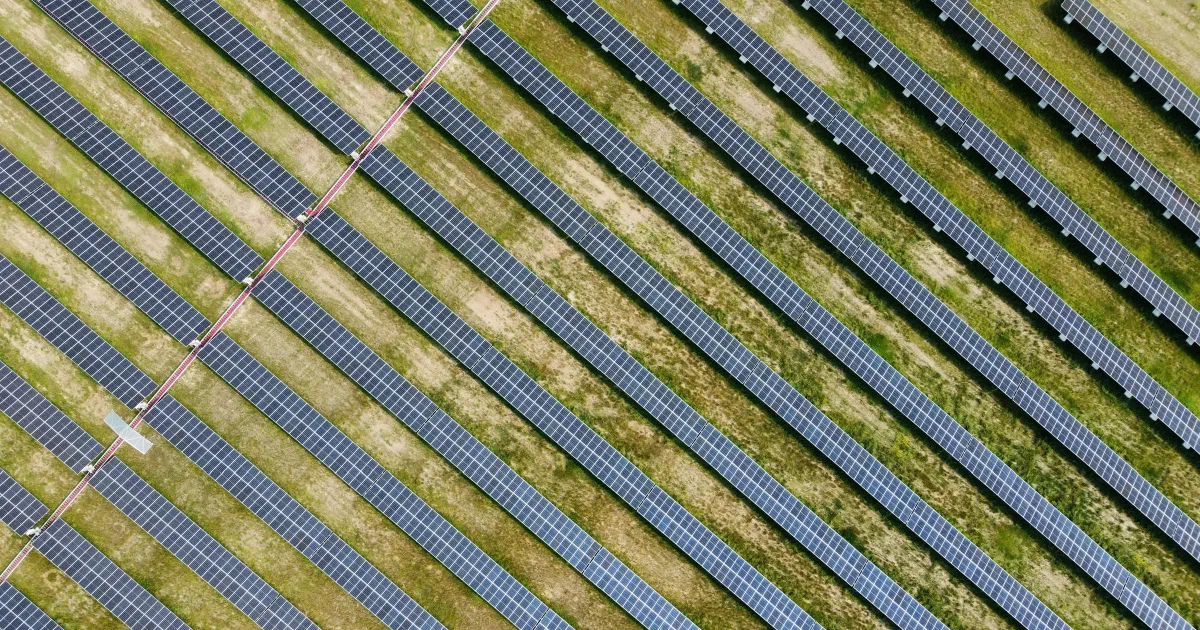
Community solar. The U.S. Department of Energy (DOE) describes community solar as “any solar project or purchasing program, within a geographic area, in which the benefits flow to multiple customers.” In most cases the panels sit at an off-site array. You “subscribe to—or in some cases own—a portion of the energy generated,” and subscribers receive “an electric bill credit for electricity generated by their share of the community solar system,” usually applied directly to your monthly bill. You typically pay the project less than the credits are worth; in an EnergySage example, $1 of bill credit costs 90 cents. Your utility still delivers your power.
How the credit shows up varies. Minnesota’s Commerce Department describes two models: one where your bill shows “a credit based on the dollar value of your share,” and an energy credit model where your share of output is subtracted from the usage on your bill.
Rooftop solar. You own (or lease) panels on your own home. Power you use as it’s produced directly cuts what you buy from the utility. Power you send to the grid is credited under your utility’s net metering or net billing rules, which differ a lot by state and utility. Our net metering guide by state explains those differences.
Side by side
| Community solar | Rooftop solar (owned) | |
|---|---|---|
| Up-front cost | Usually none (“Most community solar options charge nothing upfront,” EnergySage) | Median $2.57 per watt before incentives, first half of 2026 (EnergySage) |
| Typical savings | Most subscribers save 5% to 20% a year (EnergySage) | Depends on system size, roof, local rates and export credit rules |
| Federal residential tax credit | Not a factor in 2026 | None for home systems completed after Dec. 31, 2025 (IRS) |
| Contract | Varies: some cancel with notice, some run 20 to 25 years | You own the equipment; loans or leases have their own terms |
| If you move | Often kept if you move within the same utility area (Minnesota Commerce); check fees | Owned panels normally stay with the house |
| Who it suits | Renters, shaded or unsuitable roofs, short stays | Owners with a suitable roof who plan to stay |
| Availability | Only where a state or utility program exists | Wherever your roof, local permits and utility rules allow |
Availability is the first filter for community solar. NREL says “24 states and the District of Columbia have policies that enable community solar” (as of February 2025), and projects fill up. In New Jersey, for example, Atlantic City notes that capacity “is limited and available on a first come first served basis.”
A worked example: what each could save
These figures are illustrations to show the method. Swap in your own numbers from your bill.
Assumptions
- Usage: 899 kWh a month, EIA’s average for U.S. residential customers (2022, the latest year on EIA’s FAQ).
- Price: 18.16¢ per kWh, EIA’s U.S. average residential price for August 2026 (released October 23, 2026). This average includes fixed charges spread across each kWh.
- Monthly bill equivalent: 899 × $0.1816 = about $163.26.
Community solar at a 10% discount. If your subscription were sized to cover all of your usage and the credits were worth the full 18.16¢ per kWh, a 10% discount would save about $16.33 a month ($163.26 × 10%), or about $196 a year. At 5% it would be about $8.16 a month; at 20%, about $32.65.
That is a best case. In practice:
- The discount applies to the credits, not your whole bill (EnergySage). Fixed customer charges are not discounted.
- The credit may be worth less than the full retail price per kWh, depending on the program, so the dollar savings can be smaller. Treasury’s advisory says the agreement should disclose the expected bill credit rate; ask for it in cents per kWh.
- Savings can vary month to month, because the array produces less in winter.
Rooftop solar. At EnergySage’s median of $2.57 per watt, a 7 kW system would cost about $17,990 before any state or utility incentives (7,000 W × $2.57). With no federal credit for 2026 installs, that is the starting figure. How fast it pays back depends on how much power the system makes on your roof and how your utility credits exports. Suppose, purely as an illustration, the system cut your bill by $120 a month. Simple payback would be about 12.5 years ($17,990 ÷ $1,440 a year), before loan interest, maintenance or rate changes. After that, most of the savings would be yours, which is why rooftop solar usually wins over the long run. If your roof is shaded or your utility pays little for exports, the savings are lower and payback longer. Our solar system size calculator estimates output for your location.
The bottom line of the example. Community solar might save roughly $100 to $400 a year in our example with no investment and little risk. Rooftop solar asks for a large up-front sum (or a loan) but can cut a much bigger share of the bill for decades. EnergySage reaches the same general conclusion: “You’ll save the most in almost every situation by installing solar panels at home,” with community solar as the option when that isn’t feasible.
When community solar makes more sense
- You rent, or live in a condo or apartment where you can’t put panels on the roof. DOE says community solar “can be a great option for people who are unable to install solar panels on their roofs.”
- Your roof won’t work: heavy shade, wrong orientation, too small, or due for replacement. NREL says “42% of households and 44% of businesses are unable to utilize behind-the-meter solar.”
- You may move within a few years and don’t want to recover a large investment.
- You can’t or don’t want to borrow thousands of dollars.
When rooftop solar makes more sense
- You own the home, have a sunny roof in good condition, and plan to stay long enough to pass the payback point.
- Your utility credits rooftop solar reasonably, through net metering or a fair export rate.
- You want backup power. Pairing panels with a home battery can keep some circuits running in an outage; community solar can’t. See whether solar panels work in a power outage.
Contract terms to check before you sign
Community solar contracts vary widely. DOE’s best-practice list says to look for “No exit fees, termination fees, sign-up fees, or other fees included in the contract,” and to check your state’s consumer protections. A Treasury Department consumer advisory suggests asking:
- “Am I ensured a bill credit or monthly electric bill savings?”
- “How long does the contract last?”
- “Can I cancel the contract early? Are there cancellation fees or other charges?”
- “What happens to my contract if I move to a new address?”
- “Will the monthly subscription price stay the same during the contract term?”
Terms differ by program. Minnesota’s Commerce Department says commitments for its community solar gardens are “often 20-25 years, but in limited instances, may be year-to-year,” while EnergySage says many programs don’t require a long commitment and you can typically cancel without a penalty after giving notice. Atlantic City says the New Jersey projects it supports have “no sign up, cancellation fees, or credit requirements.” Get the term, notice period and any fee in writing.
For rooftop solar, the key documents are the installer’s proposal and any loan or lease. Our guide to comparing solar quotes lists the numbers to check, including the cash price and production estimate.
Is community solar still growing?
Yes, but unevenly. Wood Mackenzie said in April 2026 that cumulative U.S. community solar installations reached 10.1 GWdc at the end of 2025, and it expects installations to rebound 12% in 2026, then contract an average of 5% a year through 2030 in existing state programs, though new state programs could add upside. Our earlier report on community solar subscriptions and cancellations covers subscriber trends. What it means for you: if a project in your area is enrolling, compare its written terms now rather than assuming the same offer will be there later.
Sources and verification
| Important claim | Source | Status |
|---|---|---|
| Definition of community solar; bill credits; suits people unable to install on roofs; best practice of no exit fees | DOE, Community Solar Basics | Verified |
| 24 states and D.C. have enabling policies (Feb. 2025); 42% of households can’t use behind-the-meter solar | NREL, Community Solar | Verified |
| Most subscribers save 5% to 20%; most options charge nothing up front; rooftop usually saves more | EnergySage, Community solar | Verified (industry source; EnergySage also runs a rooftop solar marketplace) |
| Median $2.57 per watt before incentives, H1 2026 | EnergySage, H1 2026 market report | Verified (industry source) |
| 25D credit not allowed for expenditures after Dec. 31, 2025 | IRS, FAQs on Public Law 119-21 changes | Verified |
| 899 kWh a month average residential use (2022) | EIA FAQ | Verified |
| 18.16¢/kWh U.S. residential average, August 2026 | EIA, Electricity Monthly Update | Verified |
| Credit models; 20 to 25 year commitments; moving | Minnesota Commerce Department, community solar tips | Verified |
| Questions to ask before signing | U.S. Treasury consumer advisory | Verified |
| No fees for Atlantic City-supported projects; limited capacity | City of Atlantic City | Verified (local program only) |
| 10.1 GWdc installed at end of 2025; outlook | Wood Mackenzie, April 15, 2026 | Verified (industry source) |
All calculations are ours, using the assumptions shown. They are estimates, not quotes.
Frequently asked questions
Is community solar cheaper than rooftop solar?
It is cheaper to start. Most community solar options charge nothing up front, while a rooftop system typically costs thousands of dollars. Over the long run, rooftop solar usually saves more if your roof and utility's crediting rules are favorable, because you avoid buying much of your power instead of getting a small discount on it.
How much does community solar save?
EnergySage says most subscribers save between 5% and 20% a year. The discount usually applies to the value of the bill credits, not your whole bill, so fixed charges and any usage the credits don't cover are not discounted. Ask the provider for the discount in writing and how the credit rate is set.
Can renters get community solar?
Yes, where a program exists. The Department of Energy says community solar can be a good option for people who cannot install panels on their own roofs, including renters. NREL says 24 states and the District of Columbia had policies enabling community solar as of February 2025.
What happens to my community solar subscription if I move?
It depends on the contract. Minnesota's Commerce Department says you can often keep a subscription if you move within the same utility's service area, and otherwise may be able to transfer or sell it. Check whether early termination carries a fee.
Do I get a federal tax credit for community solar or rooftop solar in 2026?
Not for a home rooftop system installed in 2026. The IRS says the Residential Clean Energy Credit is not allowed for expenditures made after December 31, 2025, and an expenditure counts as made when installation is completed. So don't count on a federal residential credit for either option in 2026; state or utility incentives may still apply.