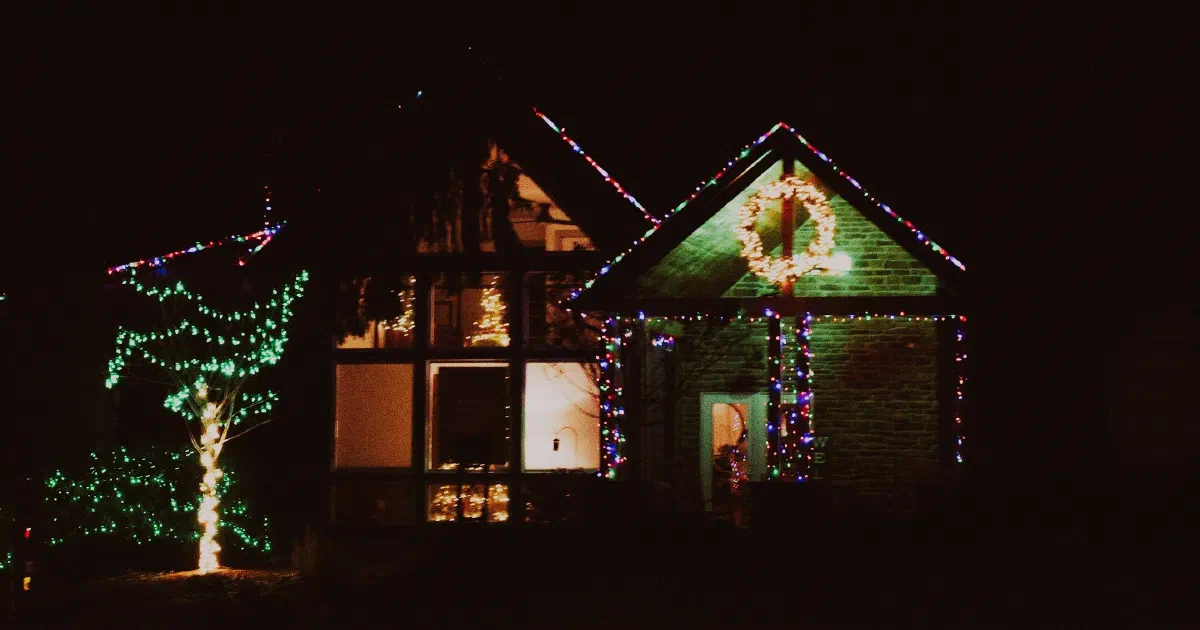
A 100-light LED mini string costs about 16 cents a month to run 6 hours a night, and a 100-light incandescent string about $1.33, at the U.S. average residential electricity price of 18.16 cents per kWh for August 2026. Big C9 incandescent bulbs cost far more: about $5.72 a month for a 25-bulb string. Your cost depends on the wattage on the label, how many hours the lights are on and what you pay per kWh.
This guide shows the formula, works through common light strings at the U.S. average and at low and high state rates, and explains why a timer matters as much as the bulbs. For background on the units, see our explainer on kW vs kWh.
The Formula
Your utility bills you for kilowatt-hours (kWh). A kWh is 1,000 watts used for one hour.
Monthly cost = (watts ÷ 1,000) × hours a night × nights × your rate per kWh
Assumptions for every example below, unless stated:
- Rate: 18.16 cents per kWh, EIA’s U.S. average residential price for August 2026 (Electricity Monthly Update, released Oct. 23, 2026).
- Schedule: 6 hours a night for 30 nights, or 180 hours.
- Wattage: the rating on specific products listed for sale, checked Nov. 8, 2026. Your lights may differ, so check the tag near the plug.
What Common Light Strings Cost
| Light string (product rating) | Watts | kWh in 180 hours | Cost a month at 18.16¢ |
|---|---|---|---|
| 100 incandescent mini lights | 40.8 | 7.34 | $1.33 |
| 100 LED mini lights | 4.8 | 0.86 | $0.16 |
| 25 C9 incandescent bulbs (7 W each) | 175 | 31.5 | $5.72 |
| 25 C9 LED bulbs (0.6 W each) | 15 | 2.7 | $0.49 |
The math for the incandescent mini string: 40.8 watts ÷ 1,000 = 0.0408 kW. Then 0.0408 × 180 hours = 7.34 kWh, and 7.34 × $0.1816 = $1.33. For the C9 string: 25 bulbs × 7 watts = 175 watts, so 0.175 kW × 180 hours = 31.5 kWh, or $5.72.
Wattage sources: a 100-count clear incandescent mini set listed at 40.8 watts (Bulb America); a 100-count red LED mini set listed at 4.8 watts, 0.04 amps, 120 volts (Christmas Central); 7-watt C9 incandescent bulbs rated at 130 volts (1000Bulbs); and 0.6-watt Bulbrite C9 LED bulbs, which the listing compares to a 5-watt incandescent (SupplyStop). These are examples, not averages for all products. The C9 rows assume a 25-socket string. Because the 7-watt C9 rating is at 130 volts, these bulbs draw somewhat less on a standard 120-volt circuit, so the C9 incandescent figures are a slight overestimate.
A Whole-House Display
Most displays use more than one string. With 10 strings on the same 6-hours-a-night schedule:
| Display | Watts | kWh in 30 nights | Cost a month at 18.16¢ |
|---|---|---|---|
| 10 incandescent mini strings | 408 | 73.4 | $13.34 |
| 10 LED mini strings | 48 | 8.6 | $1.57 |
If you leave the lights up from late November to early January, about 40 nights, multiply the monthly figure by about 1.33. Ten incandescent strings would come to about $17.78 for the season and ten LED strings about $2.09.
Inflatables, projectors and animated displays have their own motors and lights. Check each item’s label for watts and add them in the same way.
What It Costs Where You Live
Electricity prices vary widely by state. These rows use EIA’s August 2026 state averages for residential customers (Electric Power Monthly, released Oct. 23, 2026), with the same 6-hours-a-night, 30-night schedule.
| Rate | Cents per kWh (Aug. 2026) | 1 incandescent mini string | 1 LED mini string | 10 incandescent mini strings | 10 LED mini strings |
|---|---|---|---|---|---|
| Nevada | 12.72 | $0.93 | $0.11 | $9.34 | $1.10 |
| U.S. average | 18.16 | $1.33 | $0.16 | $13.34 | $1.57 |
| California | 29.75 | $2.18 | $0.26 | $21.85 | $2.57 |
| Hawaii | 47.18 | $3.46 | $0.41 | $34.65 | $4.08 |
Nevada had the lowest state average and Hawaii the highest in August 2026. State averages blend many utilities and rate plans, so your own bill shows your real price. Our guide to reading your electric bill shows where to find it, including delivery and supply charges.
LED or Incandescent?
LEDs win on electricity. In our examples, the LED mini string draws 4.8 watts against 40.8 watts for the incandescent string, about 88% less. ENERGY STAR says certified decorative light strings “consume 92% less energy than conventional incandescent lights strands” and “can last up to 10 times longer than traditional incandescent strands.”
The dollar savings per string are small for mini lights, about $1.18 a month at the U.S. average in our example. They add up with many strings, big C9 or C7 bulbs, long seasons and high-rate states. Whether replacing strings that still work pays off depends on how many you run and what new strings cost.
One other difference matters in practice:
- How many strings you can connect. One 100-light incandescent set we checked is UL listed for up to 5 strings end to end. One 100-light LED set allows up to 43 sets, “not to exceed 210 watts.” Always follow your own product’s label.
Use a Timer
Hours count as much as watts. Cutting 6 hours a night to 4 trims the cost by a third with any kind of bulb. Leaving lights on all night, 12 hours, doubles it: ten incandescent mini strings would use about 147 kWh in 30 nights, about $26.67 at the U.S. average.
A plug-in timer or smart plug turns the lights off on schedule. If you are on a time-of-use rate, evening hours may be the most expensive of the day, so a later start or earlier shutoff can save more than these averages suggest.
What About Solar?
Holiday lights run after dark, when solar panels produce nothing. How your panels help depends on your billing rules:
- Full net metering. Daytime exports earn credits at about the retail rate, which can offset evening use.
- Net billing or lower export credits. Exports may earn less than you pay for evening power, so daytime exports may cover only part of the cost of running the lights in the evening.
- Home battery. A battery charged by solar during the day can run the lights at night. Ten LED mini strings on our schedule use under 0.3 kWh a night (48 watts × 6 hours = 0.288 kWh).
For a sense of how holiday lights compare with your other uses, see how much electricity a house uses, and for a bigger winter load, what a space heater costs to run.
Sources and verification
| Important claim | Source | Status |
|---|---|---|
| U.S. average residential price 18.16 cents per kWh, August 2026, released Oct. 23, 2026 | EIA Electricity Monthly Update | Verified |
| State averages, August 2026 (Nevada 12.72, California 29.75, Hawaii 47.18) | EIA Electric Power Monthly, Table 5.6.A, released Oct. 23, 2026 (as stored on our state price pages) | Verified |
| 100 incandescent mini lights, 40.8 W; up to 5 strings end to end | Bulb America product listing | Verified (product listing) |
| 100 LED mini lights, 4.8 W, 0.04 A, 120 V; up to 43 sets, not to exceed 210 W | Christmas Central product listing | Verified (product listing) |
| C9 incandescent bulb, 7 W | 1000Bulbs product listing | Verified (product listing) |
| C9 LED bulb, 0.6 W (5 W incandescent equivalent) | SupplyStop listing of Bulbrite 770191 | Verified (product listing) |
| Certified LED strings use 92% less energy and last up to 10 times longer | ENERGY STAR, Decorative Light Strings | Verified |
| All costs, kWh and savings | Our arithmetic on the stated assumptions | Verified (recomputed) |
Frequently asked questions
How much does it cost to run Christmas lights per night?
For a 100-light LED mini string rated 4.8 watts, 6 hours a night uses 0.0288 kWh, about half a cent at 18.16 cents per kWh. A 100-light incandescent mini string rated 40.8 watts uses 0.245 kWh, about 4.4 cents a night.
Do LED Christmas lights save money?
Yes, on electricity. In our examples, the LED mini string uses about 88% less power than the incandescent string (4.8 watts vs 40.8 watts). ENERGY STAR says certified LED strings use 92% less energy than incandescent strands. Whether replacing working incandescent lights pays off depends on how many strings you run and what new strings cost.
How do I find the wattage of my Christmas lights?
Check the tag near the plug or the box. If only amps are listed, multiply amps by volts: a string drawing 0.04 amps at 120 volts uses about 4.8 watts.
Will solar panels cover my Christmas lights?
Not directly, because holiday lights run after dark when panels produce nothing. Under full net metering, daytime credits can offset the cost. On net billing or time-of-use plans, evening use may be billed at a higher rate than your exports earn.
How many light strings can I plug together?
Follow the label. Limits vary by product: one 100-light incandescent string we checked allows up to 5 sets end to end, while one 100-light LED string allows up to 43 sets, not to exceed 210 watts.